

Boarding, sitting, drop-in visits or a walk: which one does your pet need
Boarding, in-home sitting, drop-in visits or walks: how to match care to your dog, cat, bird or reptile, with what vets say about vaccines and stress.
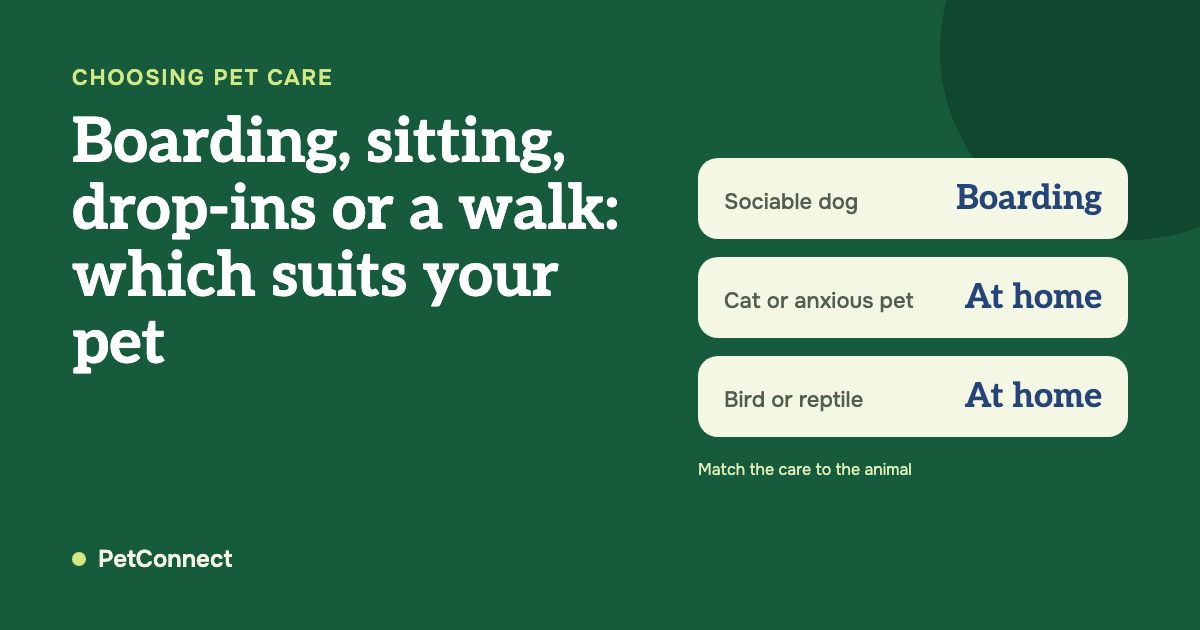
Your trip is booked, and now you have to decide where your pet will be while you're gone. The short answer is that it depends on your animal more than on your trip. A sociable dog can do well boarded, especially on a long trip. Cats, anxious pets and animals with a setup at home usually do better staying put, with a sitter or with drop-in visits. Walks fill in for dogs who need more than a quick check.
This guide goes through each type of care, who it suits, and when the other choice is the better one. For what sitting and visits cost, What pet sitting and boarding really cost, and what you are paying for has the 2026 averages.
Four types of care, and what each one means
Boarding means your pet goes to stay somewhere else, at a care provider's home or at a facility. Sitting usually means a care provider stays in your home, often overnight. Drop-in visits are shorter: someone comes by for 15 minutes to an hour to feed your pet, check on them and spend some time with them. Walks are for dogs, usually half an hour.
| Where your pet stays | Who it tends to suit | US average, where one exists | |
|---|---|---|---|
| Boarding | At the care provider's home or a facility | Sociable dogs, long trips | No reliable national figure |
| Sitting | At home, with someone staying over | Pets who need company at night, long absences | $110.43 a night |
| Drop-in visits | At home, with visits during the day | Cats, pets who are fine alone for a few hours | $28.39 for 30 minutes |
| Walks | At home, with a walk out | Dogs, on their own or with drop-ins | $28.43 for 30 minutes |
The averages come from Pet Sitters International's 2026 survey of its members. For what a whole trip costs, and why there's no boarding average we'd trust, see our guide "What pet sitting and boarding really cost, and what you are paying for".
When boarding is the better choice
Boarding gets a bad name it doesn't always deserve. For the right dog, it's a good option.
A dog who enjoys other dogs may find a few days of company more interesting than a quiet house. On a long trip, boarding means someone is around all day, not only at visit times. And if your dog needs watching more closely than a few visits allow, a place with people on hand can be the safer choice.
There is one practical thing to know. Dogs who stay where many dogs are kept together are at higher risk of kennel cough, and the American Veterinary Medical Association's page on canine infectious respiratory disease says many boarding facilities require certain vaccines. The AVMA's page on vaccinations recommends the Bordetella and canine influenza vaccines for dogs that visit places like boarding, daycare and training facilities.
The flu vaccine depends on where you live. The American Animal Hospital Association's vaccination guidelines don't recommend it for every dog, and say the decision should follow whether the virus is circulating locally, especially for dogs that board. Ask your vet about it before the trip.
When you talk to a boarding provider, ask how many other animals will be there, where your dog will sleep, how often someone checks on them overnight, and which vaccinations they require.
When staying home is the better choice
Cats
Most cats are happier at home. Cornell's Feline Health Center notes that cats tend to establish and defend their territories. A client handout from the American Association of Feline Practitioners puts it simply: cats are most comfortable with the familiar and need time to adjust to the unfamiliar.
That isn't the whole story. International Cat Care's guide to choosing a cattery says most cats adapt quickly to a good one, and that some catteries can manage treatments such as insulin injections. The same guide says most cats are very stressed sharing space with a cat they don't know. If you board a cat, ask whether they'll have their own space.
Dogs who find change hard
Research on dogs in kennels is more careful than the opinions you'll read about it. In a study of 29 family dogs measured at home and in a boarding kennel, stress hormone levels were higher in the kennel, yet the authors found no definitive evidence that the dogs were negatively stressed. An earlier study of young dogs entering a training kennel found the rise was larger, and lasted longer, in dogs who weren't used to kennels.
So a dog who has boarded happily before is a different case from one who never has. For an older dog, or one who struggles with change, staying home is usually the gentler choice.
Birds, reptiles, fish and small pets
For these animals, home is more than familiar. Their setup is part of their health.
Take a bearded dragon. Washington State University's veterinary teaching hospital says UV-B lighting is essential for it to absorb calcium, and that the wrong temperature is a common reason one stops eating or gets ill. Other reptiles have their own needs, but the point holds: the enclosure is set up for the animal, and at home it already works.
Birds are sensitive to the air around them. The AVMA's page on household hazards says birds are especially sensitive to fumes from things like overheated nonstick pans, aerosol sprays and air fresheners. Whoever cares for your bird needs to know what to keep out of the room.
A tank of fish or a pair of guinea pigs has its own routine too. For all of these animals, the best care is usually someone who comes to them and already knows the setup, or learns it from you before you leave.
Drop-in visits or a sitter who stays
If your pet is staying home, the next choice is how much company they need.
Drop-in visits suit cats and other pets who are fine alone for a few hours. One or two half-hour visits a day is common, and 30-minute visits are the most popular length, according to Pet Sitters International's industry report. At the survey's average rate, two visits a day come to about $57, which makes drop-ins the least expensive way to keep a pet at home.
A sitter who stays overnight suits pets who need company at night, a trip of more than a few days, or a house you'd rather not leave empty. At about $110 a night on average, it costs more, and what you're paying for is someone there every evening and every night.
Where walks fit in
Walks are for dogs, either on their own or added to drop-in visits. Texas A&M's veterinary college says that unless their health prevents it, all dogs need some form of daily exercise, and that the amount depends on breed and age.
For a dog who sleeps most of the day, a drop-in visit with time in the yard may be enough. For a young or active dog, add a proper walk.
A quick way to decide
Run through these with your animal in mind:
- If your dog enjoys other dogs and has boarded before, boarding is worth considering, especially for a long trip.
- If it's a cat, or a pet that finds change hard, keep them home with drop-in visits or a sitter.
- If your pet lives in an enclosure, or needs lighting, heat or medication on a schedule, keep them home with someone who knows their setup.
- If your pet is fine alone for several hours, drop-in visits are enough.
- If they need company through the night, or you're away for a week or more, book a sitter who stays.
- If your dog has energy to spare, add walks to whatever else you choose.
How PetConnect fits
PetConnect offers all four types of care: boarding, sitting, drop-in visits and walks. It's built for every species, so a pet parent with a bird or a bearded dragon books care the same way someone with a dog does. Pet parents pay no booking fee, and each care provider sets their own rates. That way you can choose the care that fits your animal, not the other way around.
Frequently asked questions
Is it better to board a dog or get a pet sitter?
It depends on the dog. A sociable dog who has boarded before can do well in boarding, particularly on a long trip. An older or anxious dog, or one who has never boarded, is usually more comfortable at home with a sitter or drop-in visits.
Do cats do better at home or in boarding?
Most cats do better at home, because they're territorial and need time to adjust to unfamiliar places. That said, International Cat Care says most cats adapt quickly to a good cattery, as long as they don't have to share space with a cat they don't know.
What vaccines does a dog need for boarding?
It varies by facility and by state, so ask the boarding provider. The AVMA recommends the Bordetella vaccine, against kennel cough, and the canine influenza vaccine for dogs that board, and the need for the flu vaccine depends on whether it's circulating where you live. Check with your vet before you book.
What's the difference between a drop-in visit and pet sitting?
A drop-in visit is a short visit, usually 15 minutes to an hour, to feed and check on your pet. Pet sitting usually means someone stays in your home, often overnight, so your pet has company for longer stretches.