

Who looks after a bird, reptile or small pet while you travel?
Who looks after a bird, reptile or small pet while you travel? The real options, what to tell the person in charge, and what vets say about each animal.
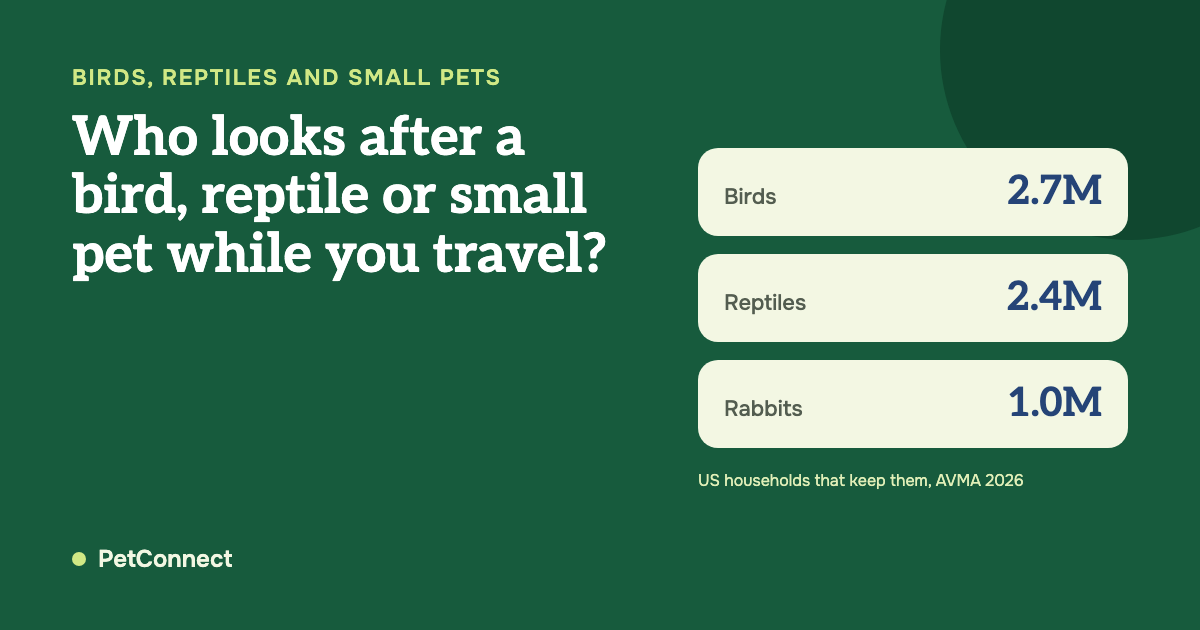
You've booked the trip, and the dog has a sitter. The cockatiel, the bearded dragon and the guinea pigs don't. You're not alone: about 2.7 million US households keep birds, 2.4 million keep reptiles, 1.2 million keep small mammals and 1.0 million keep rabbits, according to the American Veterinary Medical Association's 2026 figures. Dogs live in 58.9 million.
The short answer: most owners of birds, reptiles and small pets find care themselves, because the big pet sitting apps are built around dogs and cats. The usual choices are a friend who has kept the same kind of animal, a sitter who already looks after it, or a vet clinic or specialist store that boards it. Whoever you choose, give them the routine in writing, your vet's number, and a trial visit before you leave.
Your options, and what each is good for
- A friend who has kept the same animal. The cheapest choice and often the safest, because they already know what normal looks like. Walk them through the routine once while you're still home.
- A sitter who already cares for your kind of animal. Someone who keeps reptiles or birds themselves, or who lists them among the animals they take. Ask how many of your species they've looked after and what they'd do if the animal stopped eating.
- Boarding at an exotic-animal vet or a specialist store. Useful for an animal with a medical need. The trade-off is a new room, new sounds and less attention: one owner wrote on ParrotForums that the two local pet bird stores "do board, however they close early and are too busy to give him attention."
Your vet is often the best referral. Vets who see exotic animals tend to know who can look after them. Owners on ParrotForums put it simply: "It's hard to find bird sitters," and one added, "I found her through my Avian Vet." If you don't have one yet, the Association of Reptile and Amphibian Veterinarians runs a Find A Vet directory, and rabbit.org lists rabbit-savvy vets and boarding by country.
Reptile keepers say the hardest part is finding someone willing at all. On the MorphMarket community forum, one wrote: "Its so hard to find sitters who aren't dreadfully scared of snakes and lizards."
What the person in charge needs to know
Each kind of animal fails in its own way, so tell your carer what can go wrong, not just what to feed.
- For birds, it's the air in the room. The AVMA warns that birds are especially sensitive to fumes from aerosols, overheated nonstick pans, essential oils, tobacco, glues, paints and air fresheners. A sitter who cooks or sprays in your home needs to know that.
- For reptiles, it's heat and light. Washington State University's veterinary hospital says bearded dragons need UV-B lighting and a set heat gradient, and that the wrong temperature is a common reason one stops eating or gets ill. Show your carer the thermostat, the bulbs and the timer, and what to do if a bulb fails.
- For small mammals and rabbits, it's food and the cage. Write down the exact food and amounts, how often to clean, and the signs that mean a call to the vet.
For every animal, leave your vet's name and number, an emergency vet, how to reach you, and permission for the vet to treat.
A trial visit before you go, with you there, catches most problems while you can still fix them.
Frequently asked questions
Can a regular pet sitter look after a reptile or a bird?
Some can, but ask first. Many sitters work mostly with dogs and cats and have never handled a snake or a parrot. Ask how many of your kind of animal they've looked after, and have them do a visit with you before your trip.
Do vets or pet stores board birds, reptiles and small pets?
Some do. Clinics that see exotic animals and specialist stores sometimes board them, which helps when an animal needs medicine. Ask about opening hours and how much attention your animal will get, because boarding means a new place and fewer visits.
What should I leave for the person looking after my exotic pet?
The daily routine in writing, the exact food and amounts, how the heat and lighting work, your vet's and an emergency vet's numbers, how to reach you, and the signs that something is wrong. For birds, add the list of fumes to avoid.
Is it better to board an exotic pet or keep it at home while I travel?
For most birds, reptiles and small pets, home is easier, because their setup is hard to move and a new place adds stress. Boarding makes more sense when an animal needs medicine or close watching that a sitter can't give.
What PetConnect does
PetConnect is a pet care app for every kind of pet, from dogs and cats to birds, reptiles, rabbits and horses. Care providers choose the animals they look after, and search puts the providers who care for your kind of animal at the top. Pet parents pay no booking fee. Its founder, a pet sitter herself, started it because owners of birds, bunnies, lizards and other animals had, in her words, "nothing to connect you with someone who can love these animals for you while you're away."