

What pet sitting and boarding really cost, and what you are paying for
What a pet sitter costs in the US in 2026, per visit, overnight and live-in, what changes the price, and the booking fee some apps add on top of it.
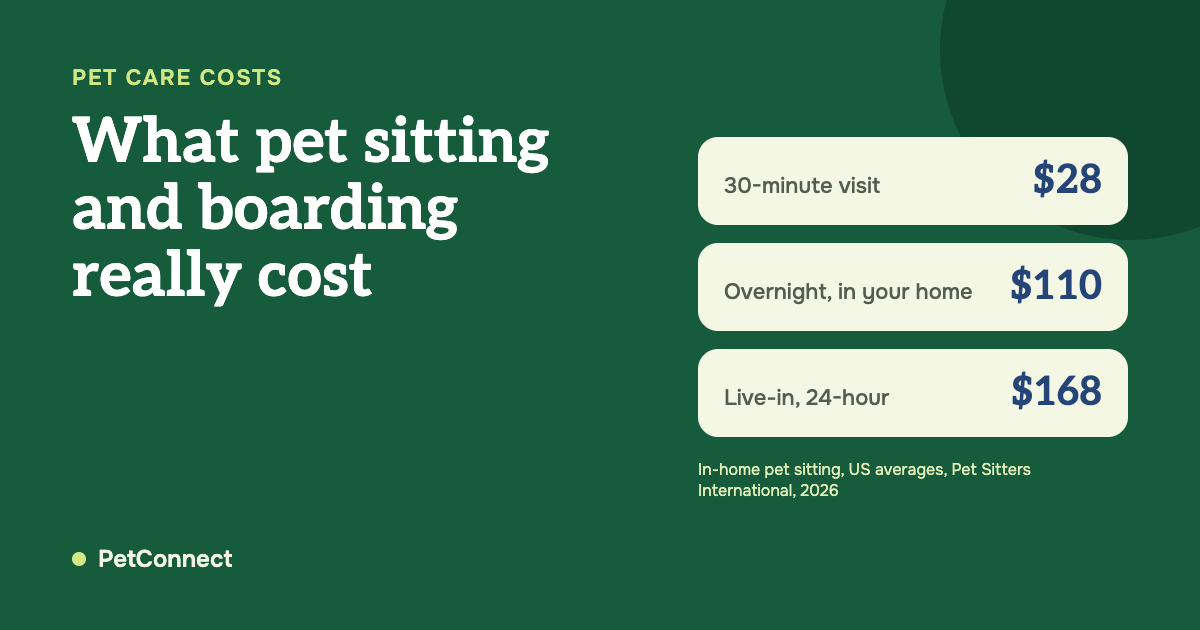
You have a trip booked and an animal who can't come with you, and the first thing you want to know is what care will cost. In the US, a professional pet sitter charges on average about $28 for a 30-minute visit, about $46 for an hour and about $110 for an overnight stay, according to Pet Sitters International's 2026 survey of its member businesses.
What you end up paying can be more than that, because some apps add a booking fee on top of the sitter's rate.
So there are two prices in any booking: what the care costs, and what you're charged to book it. This guide takes them one at a time, so you can tell which part of a quote is the care and which part is the fee.
What a pet sitter charges for a visit
A visit is the simplest thing to price. A care provider comes to your home, feeds your animal, checks the water, cleans up, gives any medication and spends some time with them before leaving. The longer they stay, the more it costs.
These are the US averages from the 2026 State of the Industry Survey by Pet Sitters International (PSI), a trade association that surveys its member businesses every two years.
| Visit length | Pet sitting visit | Dog walk |
|---|---|---|
| 15 minutes | $20.64 | $20.71 |
| 20 minutes | $24.61 | $24.02 |
| 30 minutes | $28.39 | $28.43 |
| 45 minutes | $37.98 | $38.11 |
| 60 minutes | $46.26 | $46.98 |
Two things stand out. A dog walk and a sitting visit of the same length cost almost exactly the same, so you're paying for time rather than for the activity. And the half hour is where most people land: PSI reports that 30-minute visits are the most popular with clients.
Treat these numbers as a starting point, not a quote. They're averages across professional sitting businesses that belong to PSI, and a care provider near you may charge more or less. What the table gives you is a way to tell whether a quote sits in the normal range or far outside it.
A day of care is usually a number of visits added up. Two 30-minute drop-in visits a day at the average rate come to about $57. Three come to about $85.
Overnight stays and live-in care cost more, for a reason
When someone sleeps at your home, the price changes shape. PSI's 2026 average for an overnight stay in the US is $110.43, and for live-in or 24-hour care it's $167.62.
That's more than an hour-long visit, but far less per hour.
You're paying for someone to be there: lights on in the evening, a person in the house at night, and the routine your animal knows kept as close to normal as possible. For a dog who struggles alone, a cat who needs medication twice a day, or a home you'd rather not leave empty, it's often worth it.
Over a week, the averages add up quickly. Seven overnight stays come to about $773. Seven days of live-in care come to about $1,173.
What a long weekend costs, two ways
Say you leave on Friday and come back on Monday. There are two common ways to cover it at home, and the averages show how far apart they are.
With two 30-minute drop-in visits a day for four days, the care comes to about $227. With a care provider staying three nights, it comes to about $331. The second costs about $100 more, and for that your pet has someone with them every evening and every night you're away.
Neither is the right answer for every animal. A cat who's happy on their own may be fine with visits. A dog who paces when the house goes quiet probably isn't.
Boarding is a different arrangement, with its own price
Boarding means your pet goes to stay somewhere else, either at a care provider's home or at a kennel. It isn't part of the PSI figures above, which cover care in your own home. We haven't found a national average for boarding that we'd trust enough to quote, and the price depends a great deal on the place, the size of your animal and what's included.
So compare what the price covers, not only the number. Ask how many other animals will be there, where your pet sleeps, how often someone checks on them overnight, and whether walks or playtime cost extra. Boarding can be the better choice for some animals: a sociable dog who enjoys company, or a long trip where you'd rather your pet be with someone all day.
If you're still deciding between boarding and care at home, Boarding, sitting, drop-in visits or a walk: which one does your pet need goes through who each one suits.
What moves the price up or down
Beyond the length of a visit, a handful of things change what a care provider will quote you. It's better to ask about each of them up front than to find them on the bill.
- How many animals you have, and whether a second pet is included or added to each visit.
- Medication and special care, such as injections, a strict feeding plan, or an older animal who needs help getting up.
- Your dates, since holidays or last-minute bookings may cost more.
- Distance, if you live outside the area a care provider usually covers.
- Where you live. The PSI figures are national averages, and rates in a big city and a small town won't be the same.
None of these is unfair. Each one means more time, more responsibility or more travel for the person looking after your pet. What matters is that you know about them before you agree to anything.
Birds, reptiles, fish and small pets: there's no average yet
If your animal is a parrot, a bearded dragon, a tank of fish or a pair of guinea pigs, most cost guides have nothing for you. That includes this one, at least for a number. None of the national figures we found separates care for these animals from care for dogs and cats.
What we can tell you is what you're paying for.
Looking after a bird or a reptile well takes knowledge a dog walker may not have: the right temperature and light in an enclosure, a feeding schedule that can't slip, and how to tell when something is wrong with an animal that can't show it the way a dog would.
Fewer people offer that care, so you may have fewer choices, and someone with real experience may reasonably charge more for it.
When you get a quote, ask the care provider what animals they've looked after before. Ask how they'd handle your animal's enclosure, feeding and handling, and what they'd do in an emergency. Good answers to those questions are worth more than a low rate.
PetConnect is built so that a pet parent with a bird, a reptile or a small pet can find care the same way someone with a dog can. It's the part of pet care that's hardest to find, and it shouldn't be.
The fee on top of the rate
This is the part that catches people out. On some pet care apps, the total you pay at checkout is the care provider's rate plus a booking fee charged to you, the pet parent. Separately, the app keeps a share of what the provider earns.
Rover publishes both, which makes it a clear example. Its help page on service fees says that in the US, outside California, pet parents pay an 11% booking fee finalized at checkout, and care providers pay a 20% service fee on each booking, taking home 80% of what they earn. The same page says the price on a provider's profile already includes the provider's fee.
So the fee reaches you twice. You pay the 11% directly, and the provider's 20% is already part of the rate you see. On a week of overnight stays at the PSI average of about $773, an 11% booking fee adds about $85.
Fees change over time and differ between apps. If you book through Wag or another app, the summary screen before you pay is where any booking fee shows, so look for it there and work out what it adds.
What pet sitting apps charge pet parents, and who pays what compares each app's fees side by side.
How PetConnect prices care
PetConnect works differently, and it's worth being plain about how.
Each care provider sets their own rates. As a pet parent, you pay no booking fee, so the price you agree with a provider is the price of the care. Providers pay PetConnect a monthly subscription instead, and it starts only after their first completed booking.
You see a price once you've chosen the animal, the dates and the service. Before that, you can ask a provider for a quote. If you'd like to thank someone for good care, you can leave a tip after the service, when you actually know how it went, rather than at checkout.
That doesn't make every booking cheaper than anywhere else. A provider's rate is their own, and it reflects their experience, where they live and the animals they look after. What it does mean is that the number you agree to is the care, with no booking fee added for you.
Before you book anyone
Price is one part of the decision. The other is whether this person is right for your animal.
Read what other pet parents wrote after a completed booking with them. Ask how they'd keep your pet's routine, what they'd do if something went wrong, and who they'd call. If you can, meet them first and watch how your animal reacts. A care provider who asks you a lot of questions about your pet is usually a good sign.
What to ask before you leave your pet with someone has the full list of questions, from Pet Sitters International's interview checklist.
Choosing what fits your pet and your budget
If your pet does well with a short visit or two a day, drop-in visits are the least expensive way to keep them at home: about $57 a day for two half-hour visits at the average rate.
If they need company through the night, or you'd rather the house wasn't empty, about $110 for an overnight stay is the honest price of that. And wherever you book, look past the rate to the total, because the fee is part of what care costs.
Frequently asked questions
How much does a pet sitter cost per day?
It depends on how many visits your pet needs. At the 2026 US average of $28.39 for a 30-minute visit, reported by Pet Sitters International, two visits a day come to about $57 and three to about $85. An overnight stay, with the sitter sleeping at your home, averages $110.43.
How much does an overnight pet sitter cost?
Pet Sitters International's 2026 survey puts the US average for an overnight stay at $110.43, and for live-in or 24-hour care at $167.62. Ask whether more than one animal, medication or holiday dates change the price.
Is dog walking cheaper than a pet sitting visit?
Not really. In the same survey, a 30-minute dog walk averages $28.43 and a 30-minute pet sitting visit $28.39. At every length from 15 minutes to an hour, the two cost almost the same.
Do pet sitting apps charge the owner a booking fee?
Some do. Rover, for example, charges pet parents in the US an 11% booking fee at checkout, outside California, according to its help centre. Amounts vary by app and change over time, so check the booking summary before you pay. PetConnect charges pet parents no booking fee, and care providers pay a monthly subscription instead.